

For many maize millers across Africa, the start of the year brings immediate pressure. Orders increase. Production ramps up. The focus shifts quickly to meeting demand.
But high-performing milling operations understand something critical:
It’s not just about milling more maize. It’s about milling the right product for the right market – consistently.
Build readiness before peak production – and before the market decides for you
Once peak season arrives, there is little room for adjustment. Equipment failures are costly, but so is producing a product that does not align with market expectations.
Different regions demand different results:
- Finer or coarser maize meal
- Specific particle size distribution
- Higher or lower extraction rates
- Distinct product textures preferred by local consumers
High-performing mills prepare early by reviewing not only equipment condition, but also whether their current plant configuration supports their target market.
Because machines don’t automatically produce the perfect product. They must be set to do so.
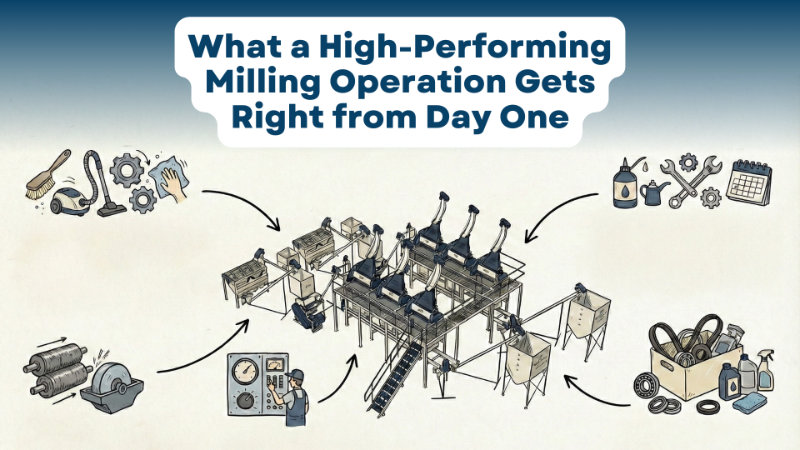
Five practical steps to strengthen performance and product precision
1. Inspect and Clean Milling Equipment:
Residue and buildup reduce efficiency and affect product consistency. Cleaning roller mills, sieves, conveyors, and aspiration systems ensures both mechanical reliability and stable product quality. Consistency starts with a clean system.
2. Schedule Preventive Maintenance:
Lubrication, bearing inspections, belt alignment, and system checks prevent unexpected downtime during peak demand. Small actions early protect production capacity later.
3. Reflute and Sharpen Rollers:
Roller condition directly influences extraction rate, energy efficiency, and particle size consistency. Worn rollers do not only reduce output – they also compromise product uniformity. Refluting restores optimal performance, improves efficiency, and supports the production of consistent, high-quality maize meal.
4. Calibrate and Configure for Your Target Market:
Strategic milling separates average operations from high-performing ones. Adjustments to roller gaps, feed rates, sieve configurations, and moisture levels determine the final product profile – influencing particle size, texture, extraction, and consistency.
These are not just technical settings; they are strategic business decisions. For example, Maize Master is currently assisting a client in Botswana to fine-tune their plant to meet specific regional market requirements.
Because no two markets are identical – and your mill should reflect your customers, not a generic standard.
5. Stock Critical Spares and Maintain Flexibility:
Having essential spares available ensures that when adjustments are needed, whether mechanical or configuration-related – your team can respond immediately.
Operational flexibility protects both uptime and product consistency.
Strong Mills Don’t Just Produce. They Position Themselves.
Operational readiness is about more than avoiding problems – it’s about protecting uptime, maintaining quality, configuring output strategically, and aligning production with market demand. High-performing milling operations shift from reactive problem-solving to proactive performance management, and from generic output to tailored product positioning.
Because the strongest mills don’t just build production capacity ,they build market relevance.
For more information on configuring your milling plant to meet your market’s exact needs, visit: https://www.maizemaster.co.za/